
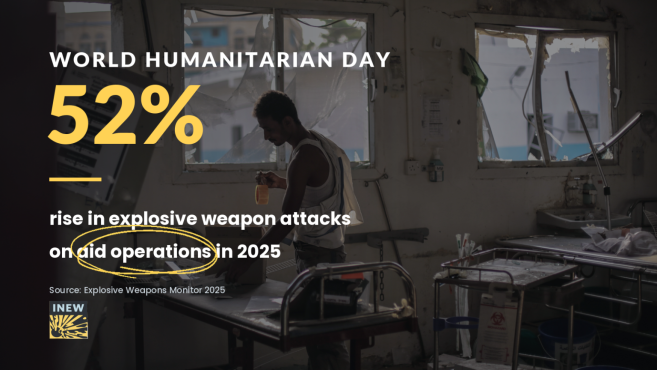
INEW calls for the protection of aid and health workers from explosive weapons in populated areas
On World Humanitarian Day, the International Network on Explosive Weapons (INEW) calls on all states and parties to armed conflict to cease the use of explosive weapons with wide area effects in populated areas, where bombing and shelling continue to kill and injure aid workers, health workers, and the civilians they assist.
World Humanitarian Day commemorates the bombing of the Canal Hotel in Baghdad, which killed 22 aid workers. Twenty-three years on, humanitarian workers are still being killed and their operations affected by explosive weapons in the towns and cities where they work.
Our research initiative, the Explosive Weapons Monitor 2025 found that at least 108 aid workers and 267 health workers were killed by explosive weapons in 2025. Attacks affecting humanitarian aid operations increased 52% in 2025 compared to the previous year. The increasing use of these systems is shrinking humanitarian space, constraining humanitarian access, and heightening risks for aid workers, with civilians ultimately bearing the consequences through reduced access to essential assistance and protection.
Almost 90% of the attacks on aid were recorded in Palestine, while incidents tripled in Myanmar and increased by 80% in Sudan. Gaza was the deadliest place in the world for aid workers, who were attacked in their convoys, warehouses and displacement camps, and as they handed out aid. Health and rescue workers were killed in “double tap” strikes, where a second attack targets those rushing to help the victims of the first.
Air-delivered weapons, including those delivered by aircraft and drones, are behind a growing share of this harm. Insecurity Insight recorded a sharp rise in incidents in which aid workers were killed or injured by air-delivered explosive weapons, from fewer than 30 in 2023 to more than 195 in 2025. This trend has continued into 2026, with armed drone use recorded in 43% of incidents where aid workers were killed or injured, compared to 17% in 2025.
The UN’s #ActForHumanity campaign for World Humanitarian Day calls on world leaders to “act now to ensure protection of civilians, including humanitarians, in conflict zones.” The weapons that put them at greatest risk are explosive weapons with wide area effects. These include artillery, mortars, rockets and air-dropped bombs. When used in populated areas, their blast and fragmentation cannot be limited to military targets, and they affect homes,
hospitals, schools, and the clinics, warehouses and supply routes that aid depends on.
But that harm does not end with the immediate blast. Damage to water, power, health and housing systems produces indirect effects that cut off essential services and the assistance people in crisis rely on. Sustained attacks also force humanitarian organizations to suspend or limit operations out of duty of care to their staff, shifting risk onto local partners, so that whole communities lose the care that humanitarian work provides. The resulting pattern of civilian harm is consistent and foreseeable.
The severity of ongoing suffering is the result of disregard shown by parties to conflict for civilian life and their obligations to protect them. The widespread use of explosive weapons with wide area effects in densely populated areas is one manifestation of this. While some actors may reject norms that safeguard civilians, this only underscores the need for the broader international community to uphold and demonstrate these standards in practice.
Ninety-two states have endorsed the 2022 Political Declaration on Strengthening the Protection of Civilians from the Humanitarian Consequences Arising from the Use of Explosive Weapons in Populated Areas The international declaration recognizes the “devastating impact” of use of explosive weapons in populated areas on civilians and calls for states to address those humanitarian consequences. In recognition of the vital role aid workers play in assisting civilian populations where explosive weapons are or have been used, the Declaration commits endorsing states to “facilitate rapid, safe, and unhindered humanitarian access to those in need”. Yet since states made that commitment in 2022,
Insecurity Insight has recorded more than 1,000 aid workers killed or injured by explosive weapons in populated areas.
This World Humanitarian Day, INEW calls on all states and parties to acknowledge this harm and act to prevent it: to refrain from the use of explosive weapons with wide area effects in populated areas and restrict all other use; to review and strengthen national policy and practice; to gather and share data on civilian harm; and to uphold the rights of victims and survivors and ensure rapid humanitarian access and assistance for those affected.